By Amanda Hopkins,
Hospitality Marketing Manager
Published by: Shaw Contract
THE PROJECT
In February 2023, Henry Ford Health, Michigan State University and Detroit Pistons owner Tom Gores announced a plan to invest $2.5 billion into Detroit’s New Center neighborhood through a joint venture, including a medical research center, hospital expansions, housing developments and public spaces.
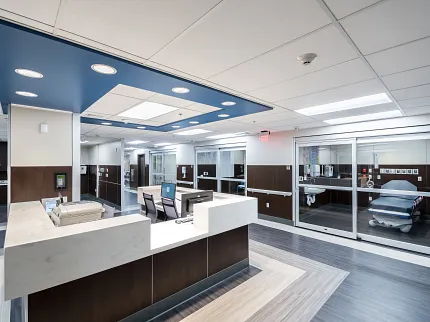
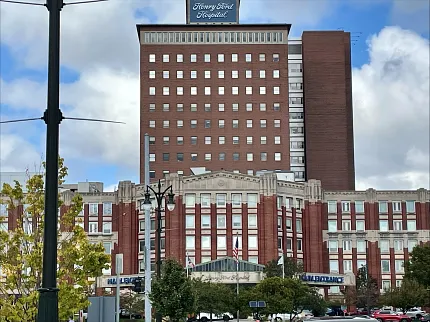
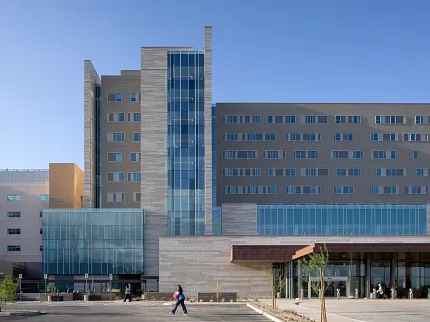
The community development project aims to turn New Center into a "vibrant, walkable community with state-of-the-art residential, commercial, retail, recreational and health care components," officials said in a press release. The health system plans to tear down the Health Alliance Plan headquarters and construct a $1.8 billion hospital in Detroit's New Center area across the street from the existing Henry Ford Hospital, officials announced. The new facilities will feature all private patient rooms, an expanded emergency department, intensive care units and advanced operating suites.
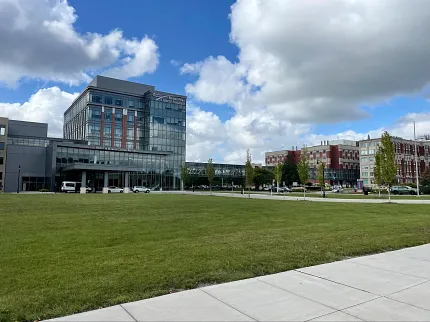
Henry Ford Health Cancer Building
THE CHALLENGE
Alongside efforts to build a new hospital campus that aims to become the “premier academic medical center and destination for the most advanced care, research and
education,” the Henry Ford Health team has a goal to reduce their environmental impact and emission. This is in alignment with The White House/HHS Health Sector Climate Pledge, a voluntary commitment to climate resilience and emsissions reduction that includes cutting greenhouse gas emissions by 50% by 2023 and achieving net zero emissions by 2050.
Creating a climate resilience plan is a key factor for hospital systems working to create a positive impact on their communities; ensuring building materials do not go to a landfill futhers this pursuit. The built environment is responsible for 42% of global CO2 emissions, 15% of that is embodied and 27% is operational (Why The Built Environment – Architecture 2030). New hospitals can contribute to patient wellbeing by focusing on healthy building materials, avoiding chemicals of concern, and addressing embodied carbon in addition to operational carbon.
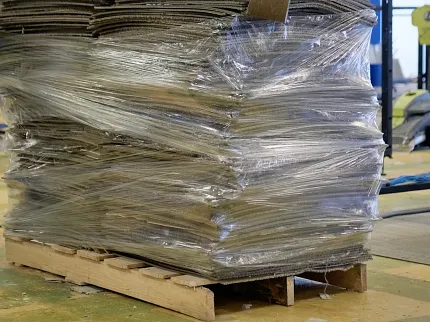
Maintaining their commitment to reduce their emissions, the visionaries at Henry Ford Health took advantage of every opportunity to reuse or recycle building materials from the Health Alliance Plan headquarters demolition. With an estimated 42,000 pounds of carpet tile, how were they going to ensure the material was recycled?
THE COMMITMENT
Henry Ford and Shaw Contract are aligned in their vision and intention to build world-class hospitals while reducing environmental impact and carbon emissions.
At the end of its useful life, Shaw Contract will reclaim and recycle EcoWorx®-backed carpet to make more EcoWorx carpet products at no cost. Since 2006, Shaw has reclaimed and recycled nearly 1 billion pounds of post-consumer carpet, reducing landfill waste.
With approximately 42,000 pounds of Cradle to Cradle Certified® Silver EcoWorx carpet installed in the Health Alliance Plan building since 2016, Henry Ford took advantage of the
opportunity to contribute to the circular economy and reduce their carbon impact during demolition of the building. They elected to utilize Shaw’s re[TURN]® Reclamation Program and by returning the carpet tile, the health system reduced the impact of their project by 15,000 pounds of CO2 or the equivalent of the amount of carbon sequestered by 8 acres of trees per year.
At Shaw Contract, we are committed to serving the healthcare segment with a deep understanding of patient-centered care, and a diverse portfolio of solution-driven flooring
products that promote healing and wellbeing. Pairing this with our passion for sustainable manufacturing allows us to positively affect both people and our planet.